


Gout Treatment in Hong Kong: Colchicine, Allopurinol and Febuxostat

A hot, swollen, red big toe that wakes you overnight is how a gout attack often starts, though any joint can be affected. Left untreated, an attack lasts one to two weeks. Gout care divides into two jobs: settling the flare you are in now, and taking a daily tablet that lowers uric acid so flares stop coming back (NICE NG219). We checked the NICE guideline, the NHS medicines pages and the UK product information for each tablet.
In short
- A flare is treated with an NSAID, colchicine or a short course of oral corticosteroid, started as early as possible.
- Colchicine for an attack is 500 micrograms two to four times a day, up to a total of 6 mg for the whole course.
- Allopurinol or febuxostat taken daily is what reduces future attacks; it starts two to four weeks after a flare settles, with cover for the first weeks.
- A hot joint with a high temperature, shivering, worsening pain or feeling sick needs urgent assessment, because an infection inside a joint can look similar.
What settles a gout attack?
The first decision is which anti-inflammatory to reach for. NICE says an NSAID, colchicine or a short course of oral corticosteroid can all be offered for a flare, chosen according to your other health conditions, the medicines you already take and your own preference. If your stomach is a concern with an NSAID, a proton pump inhibitor can be considered alongside it. Only when those options fail does NICE move to an injected corticosteroid.
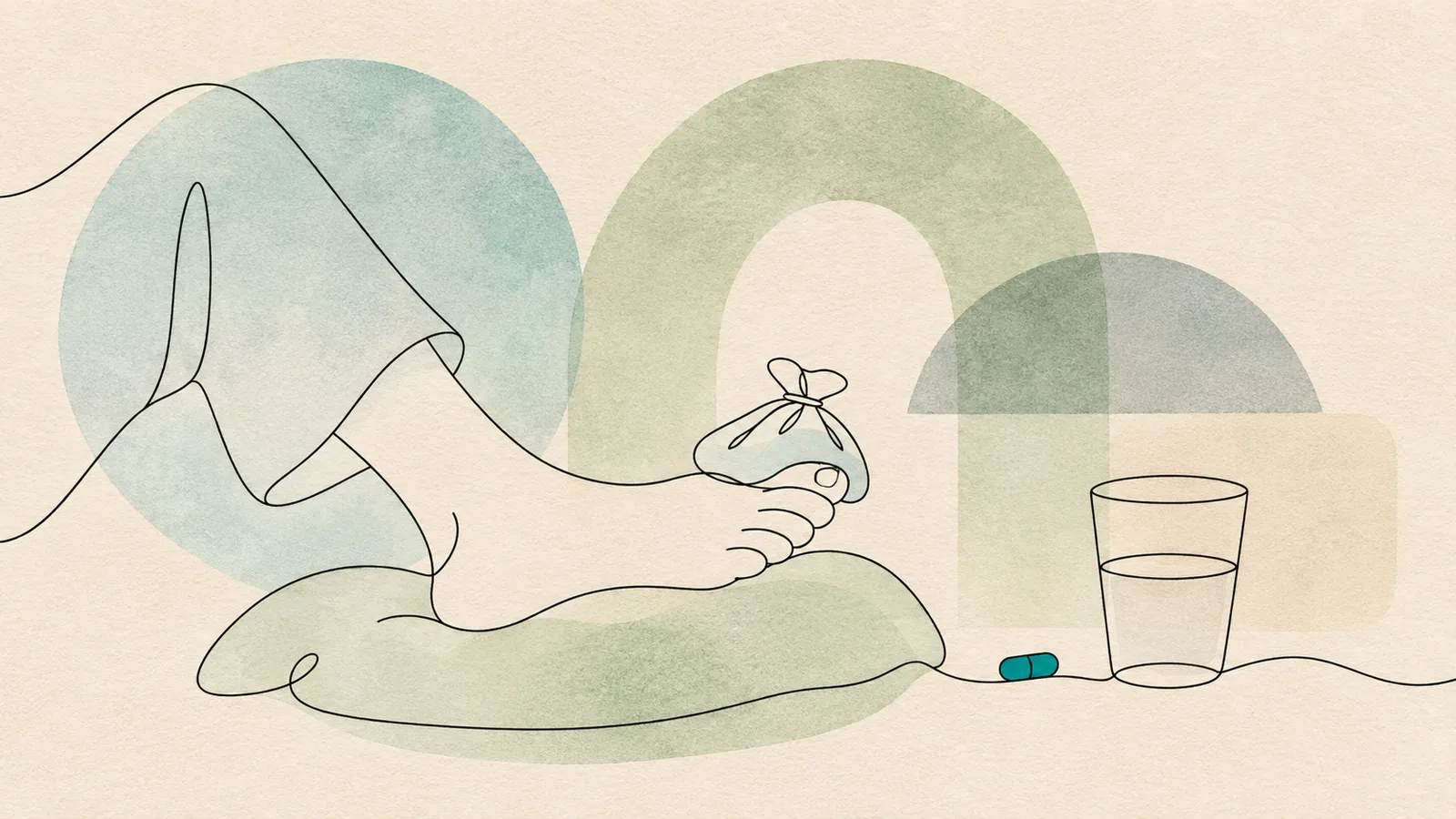
Take the medicine as soon as possible, the NHS says, because it should begin to work within two days (NHS gout). Meanwhile, rest the joint and raise the limb. An ice pack, or a bag of frozen peas, wrapped in a towel can go against it for up to 20 minutes at a time. Drink plenty of water. NICE agrees that ice on top of medicine may help.
After the flare has settled, NICE asks for a follow-up appointment to measure serum urate and review long-term treatment. That appointment is where the second job begins.
How is low-dose colchicine taken, and what makes it risky?
Colchicine has a narrow therapeutic window. In plain terms, there is not much room between a dose that helps and one that harms. The product information for an acute attack: 500 micrograms two to four times a day, until symptoms are relieved or a total of 6 mg has been taken (colchicine SmPC), and no new course for at least three days afterwards.
Do not take doses closer together than you were told. Colchicine can build up in the body, and it is extremely toxic in overdose. If you miss a dose and it is nearly time for the next one, the NHS advice is to skip it rather than double up (NHS colchicine).
Stop and get help if sickness, stomach pain or diarrhoea starts. Those are the signs that the drug is accumulating. The same applies to a high temperature, unusual bruising or prolonged bleeding, muscle pain or weakness, or dark red or brown urine. Some medicines push colchicine levels up: the antibiotics clarithromycin and erythromycin, ciclosporin, the antifungals ketoconazole and itraconazole, and verapamil among others, with fatal toxicity reported. Grapefruit juice should not be taken with colchicine. Statins, fibrates, ciclosporin and digoxin raise the risk of muscle damage.
Colchicine is not used in pregnancy, severe kidney impairment or blood disorders, and it is contraindicated in kidney or liver impairment when a P-gp or strong CYP3A4 inhibitor is also being taken. The same 500 microgram tablet is also used at 500 micrograms twice a day as cover when someone starts a urate-lowering medicine.
Which NSAID, and what about etoricoxib and indomethacin?
For most people with a flare and no other complications, an ordinary NSAID is the practical choice, with a PPI added where stomach risk is a factor. NICE lists NSAIDs as first-line for the flare (NICE), and the NHS names ibuprofen as the usual example, turning to steroids if it does not help.
Etoricoxib's UK product information is specific about gout: 120 mg once a day, which was the dose given for eight days in trials, with no more than 120 mg a day and a maximum of eight days for acute gout (etoricoxib SmPC).
Naproxen and indomethacin are also listed for gout among our painkillers, but we did not read their flare doses in a UK product sheet, so no numbers for them here. Anyone with kidney disease, heart disease or a diuretic prescription should get advice on NSAIDs before the next attack rather than in the middle of one.
How do you stop attacks coming back?
Settling a flare does nothing about the uric acid level underneath it, which is why gout keeps returning. Urate-lowering therapy is offered when flares are multiple or troublesome, or when there is kidney disease stage 3 to 5, diuretic treatment, tophi or chronic gouty arthritis. After a single flare, NICE says it should be discussed (NICE). Treatment is usually lifelong and taken between attacks, including when you feel perfectly well.
Two things about starting. The first is timing: begin at least two to four weeks after a flare has settled, never in the middle of one. The second is dose. Allopurinol starts at 100 mg a day (allopurinol SmPC), taken with food and plenty of fluids (NHS allopurinol), and the dose goes up only if the urate response is not good enough. The product information suggests 100 to 200 mg a day for mild disease and 300 to 600 mg for moderately severe disease, so 100 mg is a starting tablet, not the destination.
Target: serum urate below 360 micromol/L, which is 6 mg/dL. That drops to below 300 micromol/L (5 mg/dL) if you have tophi, chronic gouty arthritis, or flares that continue even when urate is under 360. Monthly urate checks guide each increase until you get there, and after that NICE asks for one measurement a year.
Why do attacks sometimes get worse in the first weeks, and what covers that?
Starting or increasing a urate-lowering tablet can trigger a flare. The urate-lowering tablet itself can set off an attack, which is a known effect and not a reason to stop it. The allopurinol product information warns that an attack may be precipitated in the early weeks and advises prophylaxis with an anti-inflammatory or colchicine for at least one month (allopurinol SmPC). Febuxostat goes further, recommending flare cover for at least six months with an NSAID or colchicine (febuxostat SmPC). The American College of Rheumatology guideline puts the usual period at three to six months (ACR 2020).
NICE's first choice of cover is colchicine, 500 micrograms twice a day. For people who cannot take it, a low-dose NSAID or a low-dose oral corticosteroid are the alternatives, both off-label for this purpose. A PPI can be considered alongside. And if a flare still breaks through, carry on with the urate-lowering tablet at the same dose and treat the flare as you normally would.
Should Han Chinese patients have the HLA-B*58:01 test before allopurinol?
NICE offers allopurinol or febuxostat as first-line urate-lowering treatment. Allopurinol gets extra caution in Han Chinese patients because of a gene. HLA-B*58:01 is carried by up to 20% of Han Chinese people, 8 to 15% of Thai people, about 12% of Korean people and only 1 to 2% of Japanese or European people, and the allele is associated with the severe skin reactions Stevens-Johnson syndrome and toxic epidermal necrolysis (allopurinol SmPC). Screening should be considered before starting allopurinol where the allele is common, and a known carrier should not begin it unless there is no other reasonable option.
The Hong Kong evidence for screening is small. A case-control study at the Chinese University of Hong Kong compared 19 patients who had severe cutaneous reactions to allopurinol with 30 people who had taken it without problems. All 19 patients carried HLA-B*58:01, against 4 of the 30 controls, giving 100% sensitivity and 86.7% specificity (Chiu 2012). With fifty people in total, it is one local study, not a guarantee.
A negative test is not a free pass, because these reactions can still occur in people who do not carry the allele. Any rash, blistering, mouth sores or fever in the first weeks means stopping allopurinol and getting urgent help; that is when the risk is highest. Kidney impairment and thiazide diuretics or ACE inhibitors push the risk up further.
Who should look at febuxostat, and what is the heart warning?
Febuxostat is the other first-line urate-lowering option in NICE guidance, alongside allopurinol, and NICE is explicit that allopurinol comes first for anyone with major cardiovascular disease such as a previous heart attack, stroke or unstable angina (NICE).
The caution comes from the CARES trial, which followed 6,190 people with gout and existing cardiovascular disease for a median of 32 months. The main combined heart event was similar on both drugs, but all-cause death was higher with febuxostat, with a hazard ratio of 1.22, and cardiovascular death was higher too, at 1.34 (CARES). The later FAST trial, which used dose-optimised allopurinol as the comparison, found febuxostat not inferior (febuxostat SmPC). The product information still advises caution and regular monitoring in people with major cardiovascular disease, and Hong Kong's Drug Office posted the FDA's boxed warning letter about febuxostat in 2019 (Drug Office).
Dosing follows a similar pattern to allopurinol. Do not start until the attack has completely subsided, begin at 80 mg once a day, and consider 120 mg if urate is still above 357 micromol/L after two to four weeks (febuxostat SmPC). Our Uloric (Febuxostat) listing carries 40 mg and 80 mg tablets; no 120 mg tablet is listed. Febuxostat is not recommended with mercaptopurine or azathioprine, and allopurinol should be avoided with them too.
What helps beyond tablets, and when is a hot joint not gout?
No specific diet has been shown to prevent flares or lower urate. NICE's advice is a healthy balanced diet, with the note that excess weight and heavy drinking can make flares worse. The NHS adds habits that are easier to act on: no more than 14 units of alcohol a week, several alcohol-free days, plenty of water, and fewer sugary drinks and snacks.
If a joint is suddenly painful and swollen and the pain is getting worse, and you also have a very high temperature, or you feel hot, cold or shivery, or you feel sick or cannot eat, that combination may be an infection inside the joint. Get urgent help rather than waiting it out. NICE says to suspect septic arthritis in a painful, red, swollen joint and refer immediately.
Which gout medicines does PockDose list?
| Medicine | What the listing is | The job it fits |
|---|---|---|
| Colchicine (Colchicine) | Colchicine 0.5 mg tablets (500 micrograms), packs from 60 to 360 | Treating a flare, or covering the start of a urate-lowering medicine |
| Colcrys (Colchicine) | Generic Colcrys: colchicine 0.5 mg tablets, same strength as the plain tablets; packs 30 to 360 | The same jobs, as an alternative listing |
| Allopurinol (Allopurinol) | Allopurinol 300 mg tablets, packs of 30, 60 and 90 | Long-term urate lowering at maintenance strength |
| Zyloprim (Allopurinol) | Generic Zyloprim: allopurinol 100 mg and 300 mg tablets | The 100 mg tablet is the usual starting one |
| Uloric (Febuxostat) | Generic Uloric: febuxostat 40 mg and 80 mg tablets | Long-term urate lowering, including for people who cannot take allopurinol |
| Indocin (Indomethacin) | Generic Indocin: indomethacin 25, 50 and 75 mg capsules | Listed for arthritis and gout |
| Naprosyn (Naproxen) | Generic Naprosyn: naproxen 250 and 500 mg tablets | Listed for arthritis, gout and pain |
| Arcoxia (Etoricoxib) | Generic Arcoxia: etoricoxib 60, 90 and 120 mg tablets | Listed for gout flares among other uses |
Match the medicine to the job rather than to the flare in front of you. For an attack, a colchicine or anti-inflammatory listing covers the days ahead. For prevention, allopurinol or febuxostat is a daily routine measured against your urate results, so start with the lowest strength of the urate-lowering tablet you have chosen and read the product page before the first dose. Ordering from PockDose needs no prescription; if you are unsure which listing fits, the gout and gout flares pages group them by what they are used for.
Sources
- Gout: diagnosis and management (NG219) — NICE
- Gout — NHS
- Colchicine: a medicine to treat gout — NHS
- Allopurinol: a medicine to treat gout — NHS
- Colchicine 500 micrograms Tablets: summary of product characteristics — electronic Medicines Compendium (emc)
- Zyloric (allopurinol) tablets: summary of product characteristics — electronic Medicines Compendium (emc)
- Adenuric (febuxostat): summary of product characteristics — electronic Medicines Compendium (emc)
- Association between HLA-B*58:01 allele and severe cutaneous adverse reactions with allopurinol in Han Chinese in Hong Kong (2012) — British Journal of Dermatology
- Cardiovascular safety of febuxostat or allopurinol in patients with gout (CARES, 2018) — New England Journal of Medicine


